
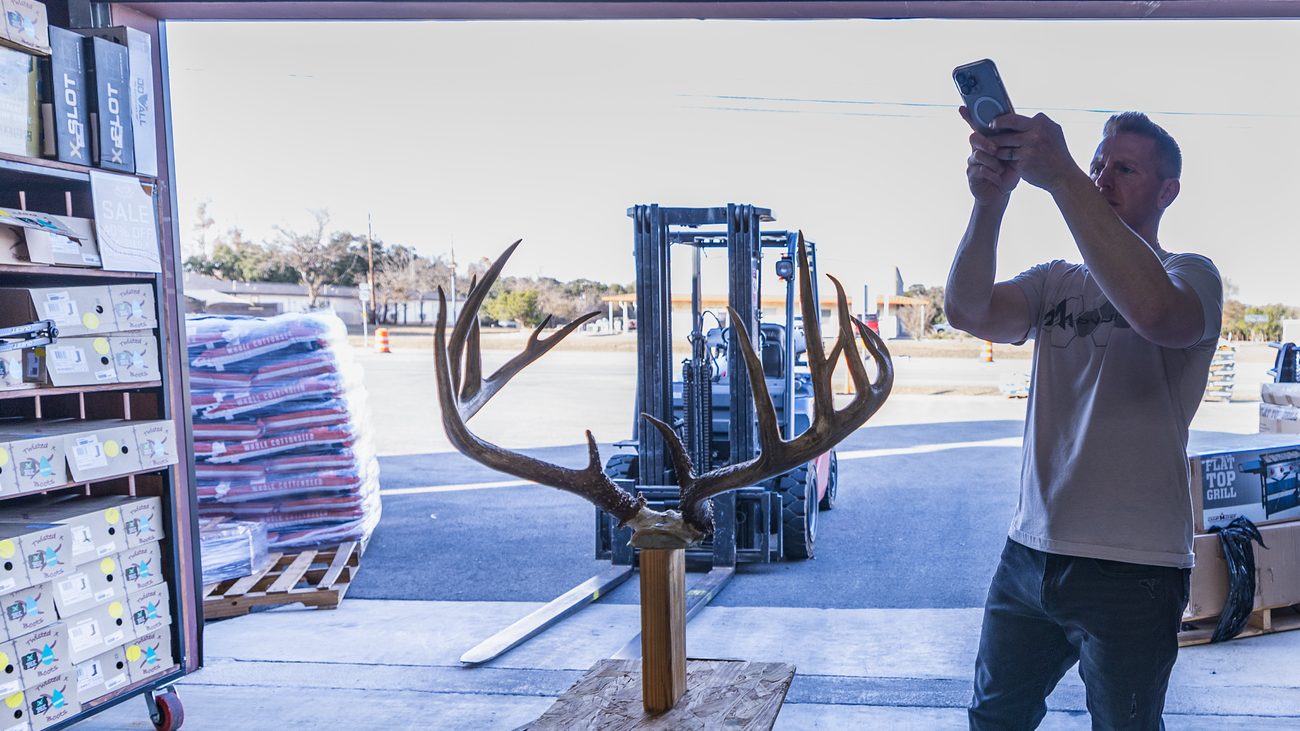
To score a deer rack, you measure the inside spread, the length of both main beams, the length of every typical tine, and four circumference measurements on each antler. Add them together for the gross score. Then subtract side-to-side differences and any abnormal points to get the net score.
For most whitetail hunters, the moment of truth comes after the shot. Punching a tag feels incredible, but when you finally get your hands around those antlers and start sizing him up, another rush hits. Hunters are storytellers, and a rack's score helps preserve that story: how old he was, what habitat produced him, and how he stacks up against the deer you've taken before.
Scoring a deer accurately takes more than laying a tape across a few points. There's a real method to it, and understanding that method matters whether you're taking your antlers to an official measurer or scanning them with your phone.
This guide walks you through how to score a buck using the same system as Boone and Crockett and Pope and Young. Whether you shot the buck of your career or you're practicing on sheds, here's how to do it right.
Why Scoring a Deer Rack Matters
Scoring isn't about ego or chasing inches. It's about documenting the animal and understanding how age, nutrition, and genetics shaped your buck. An accurate, standardized score helps you:
- Track habitat improvements on your property
- Compare your deer with historical records
- Understand the growth potential of local deer
- Find out if your buck qualifies for the record books
- Give accurate information to taxidermists and wildlife managers
Buck scoring is part measurement, part memory, and part management tool, so if you're going to do it, do it right.
Deer Scoring Cheat Sheet
| Measurement | How Many | How to Measure |
|---|---|---|
| Inside spread | 1 | Straight line at the widest point between the main beams |
| Main beams | 2 (one per side) | Along the outer curve, from the burr to the tip |
| Tines (G1, G2, G3…) | Every typical point | Along the outer curve, from the top of the beam to the tip |
| Circumferences (H1–H4) | 8 (four per side) | At the smallest spot between each set of tines |
Step 1: Understand the Scoring System
Most hunters use one of two record books:
- Boone and Crockett (B&C): for rifle, shotgun, and muzzleloader entries
- Pope and Young (P&Y): for bowhunting entries
Both use the same measurement method. To score a whitetail buck, you'll take four types of measurements: main beam lengths, point (tine) lengths, circumference (mass) measurements, and inside spread.
For a typical whitetail, symmetry matters and abnormal points count against the score. For a non-typical whitetail, abnormal points are added as extra inches. This guide focuses on typical racks, since that's how most bucks are scored.
Step 2: Gather the Right Tools
Scoring a deer rack isn't complicated, but it does take precision. You'll need:
- A flexible steel tape, about ¼ inch wide, marked in ⅛-inch increments
- A flexible steel cable or string for measuring curves (optional but helpful)
- A yardstick or carpenter's ruler for inside spread
- A pencil and an official score sheet (B&C and P&Y offer printable forms)
- A stable surface to hold the rack steady
- Good lighting
All measurements are recorded to the nearest ⅛ inch.
Step 3: Measure the Inside Spread
Inside spread is the easiest measurement, so start here.
- Set the rack so it sits in its natural position, without tilting it.
- Measure straight across at the widest point between the main beams, at a right angle to the center line of the skull.
- Record this number as your inside spread.
Note: Your inside spread credit can't be more than the length of the longer main beam, even if the rack is physically wider. This keeps extremely wide but underdeveloped racks from inflating the score.
Step 4: Measure Each Main Beam
- Start at the lowest outside edge of the burr (the bumpy ring at the base of the antler).
- Run your tape or cable along the outer side of the beam, following its curve.
- Stop at the farthest point of the beam tip.
- If you used a cable, mark it and lay it flat against your tape to read the length.
Measure both beams separately. These numbers are the backbone of your total score.
Pro tip: Main beam length often separates a nice buck from a giant. Heavy bucks with tall tines can lose inches fast if their beams are short and tight, so don't eyeball this one.
Step 5: Measure the Tines (G-Points)
Label each typical point in order along the main beam:
- G1 = brow tine
- G2 = next point toward the tip
- G3, G4, and so on
To measure each tine:
- Find the tine's baseline, where it meets the top of the main beam. Picture a line continuing along the top edge of the beam underneath the point.
- From that baseline, run your tape along the outer curve of the tine to its tip.
Common mistakes:
- Measuring in a straight line instead of following the curve
- Starting too high or too low on the beam
- Counting abnormal points as typical G-points
The main beam tip is not counted as a point.
Step 6: Take the Circumference (Mass) Measurements
Mass plays a bigger role in score than most hunters realize. A heavy, mature buck with average tines can outscore a thinner buck with more points.
Each antler gets four circumference measurements, each taken at the smallest spot in that section:
- H1: between the burr and G1
- H2: between G1 and G2
- H3: between G2 and G3
- H4: between G3 and G4
If the buck has no G4, take H4 halfway between G3 and the beam tip. Always wrap the tape straight around the beam, not at an angle.
Step 7: Account for Abnormal Points
Many bucks have at least one abnormal point, such as a sticker, kicker, or drop tine.
- Typical score: abnormal points are subtracted
- Non-typical score: abnormal points are added
Most hunters score their bucks as typical unless the rack has a lot of non-typical character.
Step 8: Add It All Up
Gross score =
Left main beam + right main beam
+ all typical tine lengths (both sides)
+ all circumference measurements (H1–H4, both sides)
+ inside spread credit
Net typical score =
Gross score
− side-to-side differences (between matching beams, tines, and circumferences)
− abnormal points
Many hunters prefer gross score because it reflects the buck's full growth. Net score is the official number record books use.
Planning to enter a record book? Official scores can only be taken after the antlers have dried for 60 days. See how to submit your trophy for official scoring.
Wondering if your number is a trophy? See what is considered a trophy buck by state and region.
Where Hunters Make Mistakes
After scoring dozens of bucks each season, we see the same errors again and again:
- Starting main beams or tines from the wrong baseline
- Measuring tines in a straight line instead of along the curve
- Guessing where the smallest circumference is
- Measuring the inside spread at an angle
- Forgetting to subtract abnormal points on a typical rack
If you want a clean score, slow down and measure carefully.
Scoring a Deer with Your Phone: The Faster Option
Scoring by hand is a great skill, but it's slow, and even experienced scorers can get different numbers on the same set of antlers. Curves are hard to follow with a tape, and finding the smallest circumference takes judgment.
Trophy Scan solves that with a 3D scan. Walk a slow circle around the antlers with your phone, and the app measures main beam length along the full curve, every tine length, mass and circumference measurements, and inside spread, and keeps a 3D model of your buck.
Because Trophy Scan measures your actual antlers rather than estimating from a photo, you get an accurate field score, shown as a range. Scoring is free, and you can have the score certified for $24.99 when you want an official number.
Want to see how it works? Learn how to score your deer with your phone.
Frequently Asked Questions
How do you score a deer for Boone and Crockett?
Measure the inside spread, both main beams, every typical tine, and four circumferences per antler, all to the nearest ⅛ inch. Add them for gross score, then subtract side-to-side differences and abnormal points for net score. Official B&C entries must be measured by an official measurer after a 60-day drying period.
Do you measure tines straight or along the curve?
Along the curve. Each tine is measured from its baseline on top of the main beam, following the outer curve to the tip. Measuring in a straight line is one of the most common scoring mistakes.
Does the inside spread count toward the score?
Yes. Inside spread is added to the score, but the credit can't be more than the length of the longer main beam.
What's the difference between gross and net score?
Gross score is the total of all measurements before deductions. Net score subtracts differences between the left and right sides and any abnormal points. Record books use net score.
Can you score a deer from a picture?
You can estimate, but photos can't show the whole rack. Camera angles distort tine length and spread, and mass is very hard to judge from a picture. For an accurate score, measure the antlers by hand or use a 3D scanning app like Trophy Scan.
Can you score shed antlers?
Yes, you can measure beams, tines, and circumferences on sheds. Without the skull, you can't take an inside spread, so the score will be incomplete compared to a full rack.
Final Thoughts
Scoring a deer rack is more than laying a tape on antlers. It's a way to honor the animal, document your success, and become a more knowledgeable whitetail hunter. Whether you're scoring a heavy 10-point, a gnarly non-typical, or a shed you found in the spring, the process teaches you how whitetails grow and what separates an average buck from a great one.
Learning to score a buck by hand is part of hunting tradition, and mastering it will make you a better judge of deer on the hoof. When you want a fast, accurate score and a 3D model of your buck, Trophy Scan is the free deer scoring app built for exactly that.